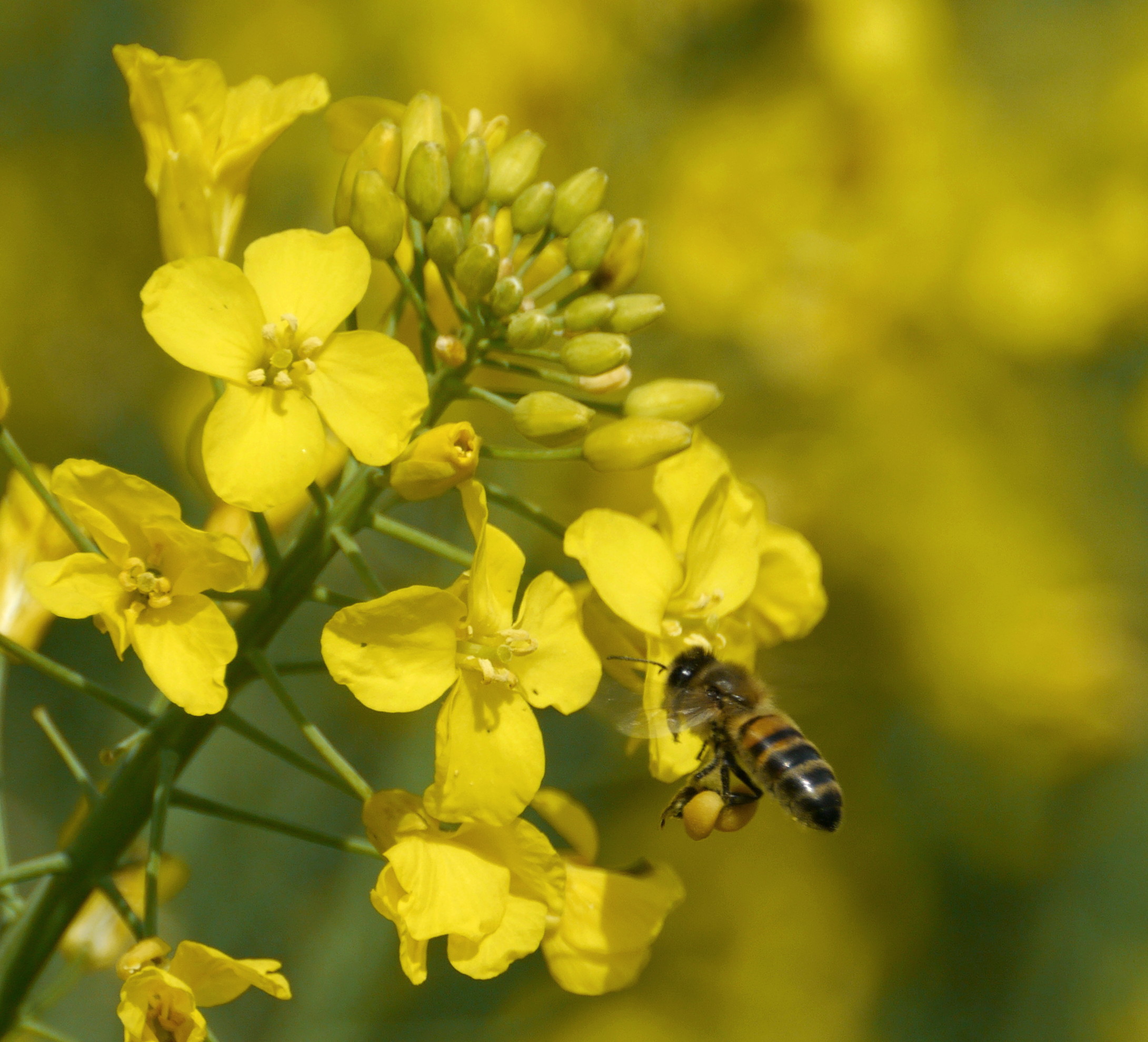
The big bee-forage news this month must be the oilseed rape (Brassica napus). Fruit trees continue to blossom in the orchard, notably the pear, cherry and quince – but the overriding draw surely comes from the distinctive bright yellow swathes, pushing up all over the countryside.
The pollen is quite evidently plentiful, and the bees are returning to the hive with baskets full to busting.
is pollen good for the complexion?
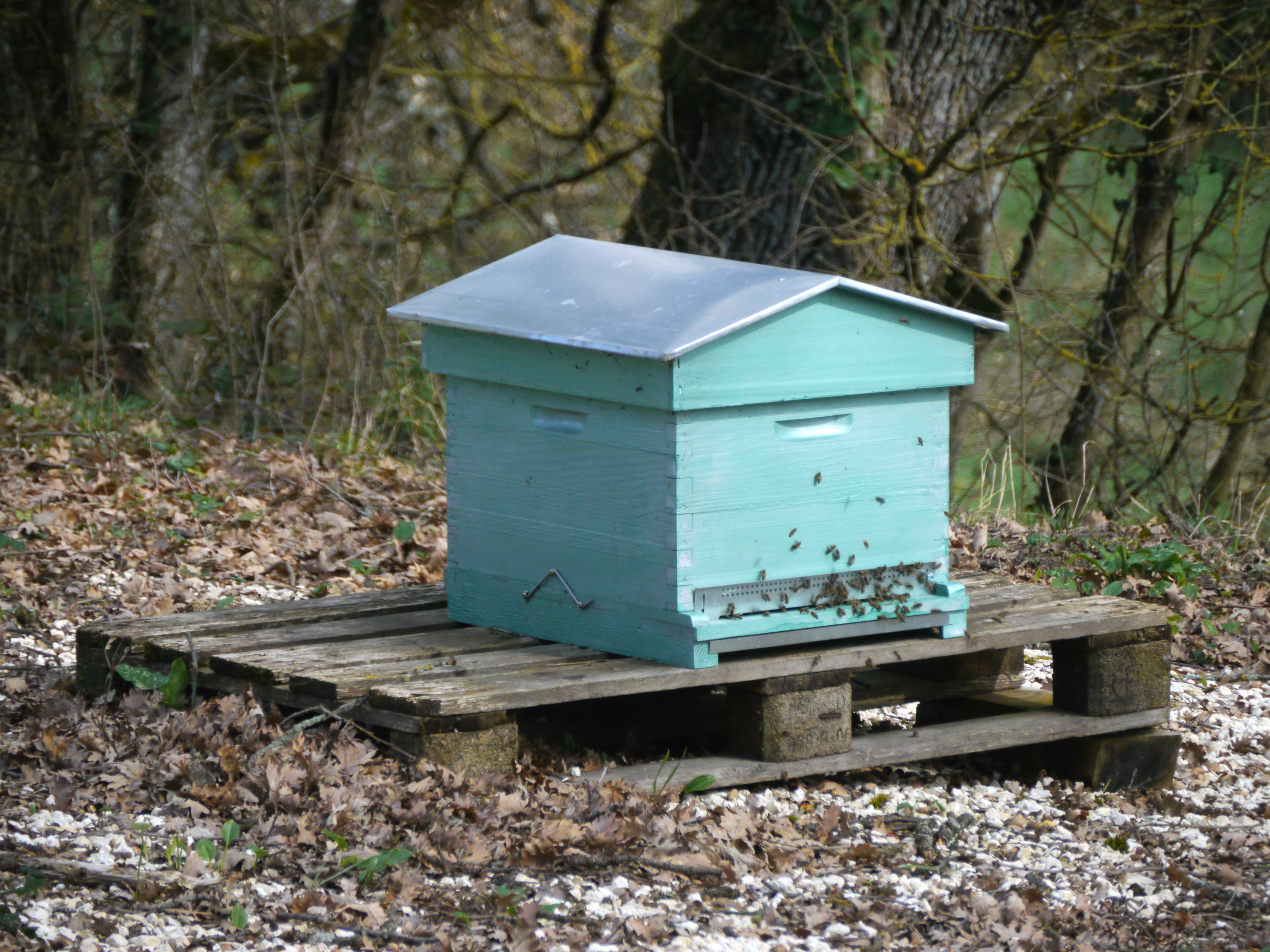
Given that this is our first April with the hive, we are mindful of the precise timing required for a rapeseed honey harvest – as this particular honey has a tendency to crystallise rapidly. We are keeping a close eye on stores within the hive, and added a super 7 days ago. We could be in for a good harvest of honey – but must ensure that it is extracted from the comb before having the chance to set rock hard.
perhaps its time to start thinking about returning your load to the hive?
Maybe the OSR honey will be tempered with nectar from the orchard blossoms, which are also quite plentiful – we shall have to wait and see!
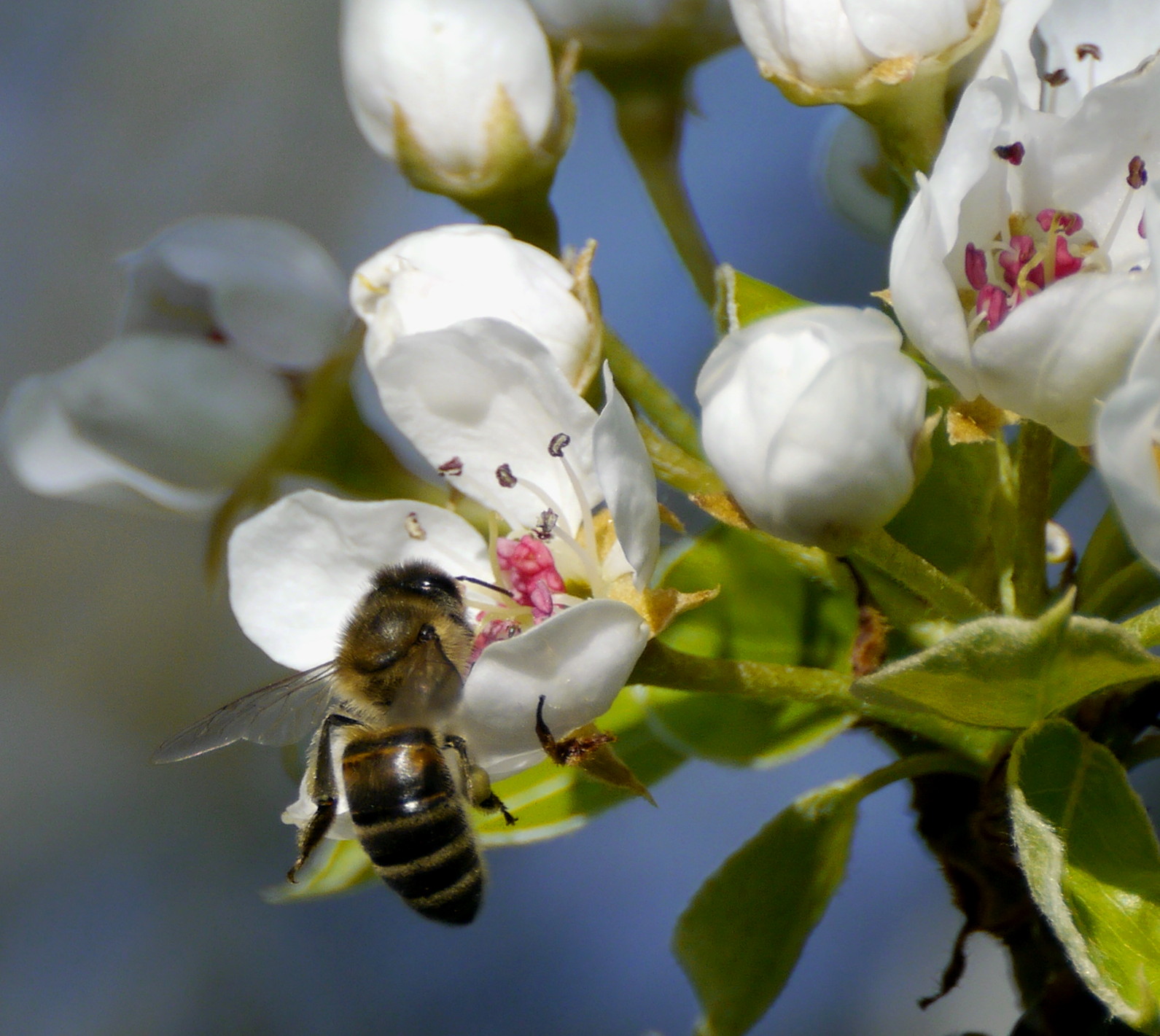
honey bee on pear blossom – doyenne du comice to be exact
honey bees on apple blossom – this one is a Bramley apple
I was given a small, mystery plant in Autumn 2010, and popped it in the ground at the top a bank, not knowing what to expect. Luckily this well-drained sunny position suited it down to a ‘t’ and it has since flourished, proliferating vigorously, and above all it turns out to be quite the bee magnet – attracting the attention of the honey bees and bumblebees.
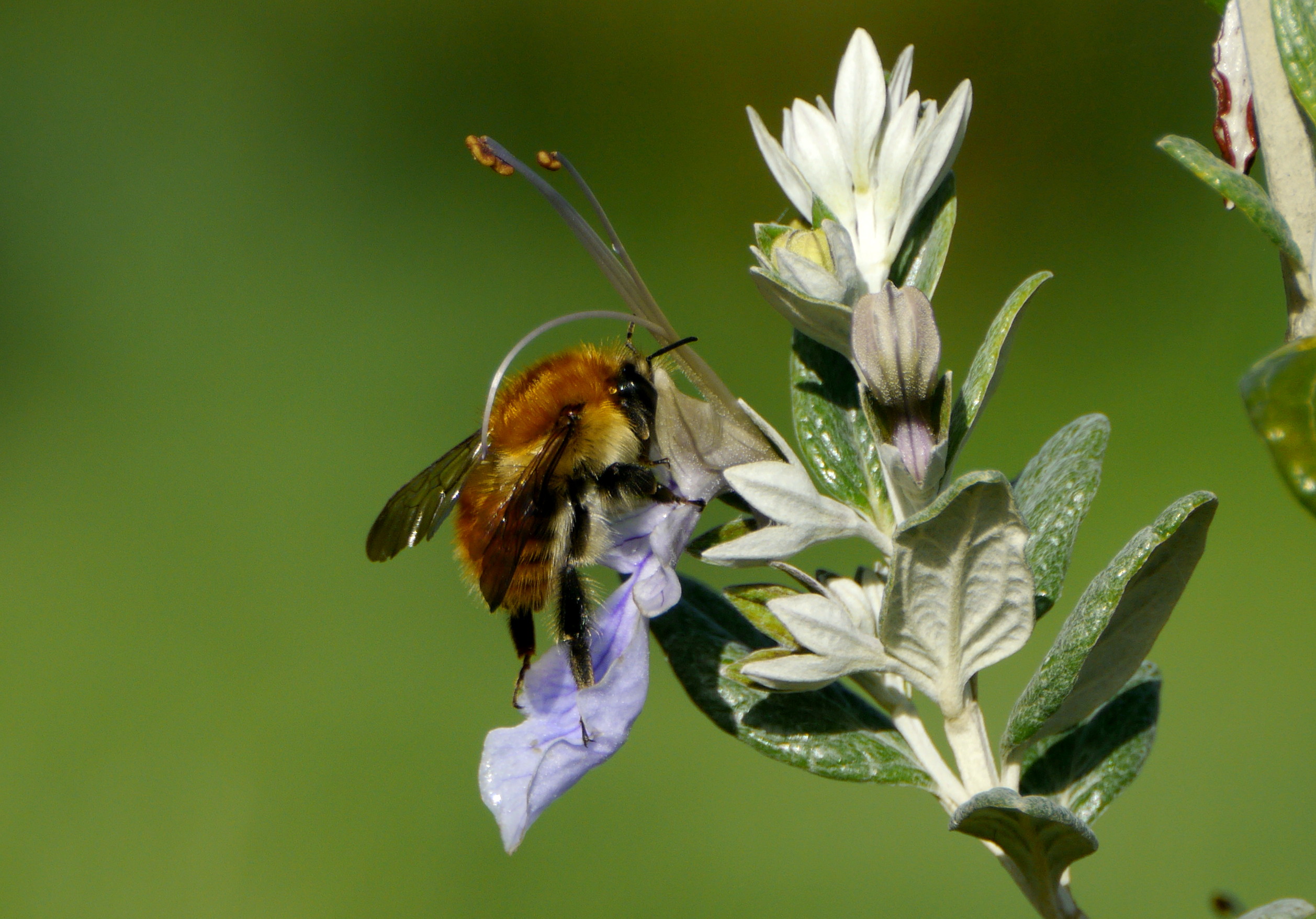
common carder bee (Bombus pascuorum) on bush germander (Teucrium fruticans)
It is a mediterranean native with downy grey-green, aromatic foliage. The flower is interesting and intricate – icy blue petals with deep purple veins, sporting great-reaching, show-off stamen, designed perfectly to rub themselves sneakily on the bee’s back as they get on with the business of sucking up nectar.
beehind you!
Teucrium was named for Teucer, the legendary first king of Troy who pioneered use of these plants as medicinals. He was a great archer and fought alongside his half-brother Ajax in the Trojan War. Fruticans, more banally, means shrubby.
Spying on the bees as they go about their outdoor pursuits has become something of a passion, and stalking them as they forage round and about the house has opened my eyes to all the various snacking places on offer.
Some of these floral opportunities are ravaged in the wink of an eye, others last a little longer. It certainly surprises me how quickly a tree / flower / shrub can be devoided of pollen.
The two main areas of activity this month have been the fruit orchard and the box trees.
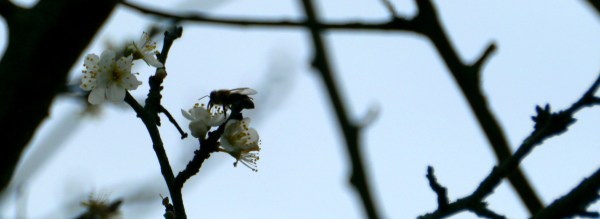
In the orchard it started with the almond trees, and then the wild, flowering plums. We have two, young, purple-leaved Prunus trees, which have pink flowers, and then a host of a white blossomed varity, which must have been here for decades.
Honey bee on Cherry Plum (Prunus cerasifera “Nigra”)
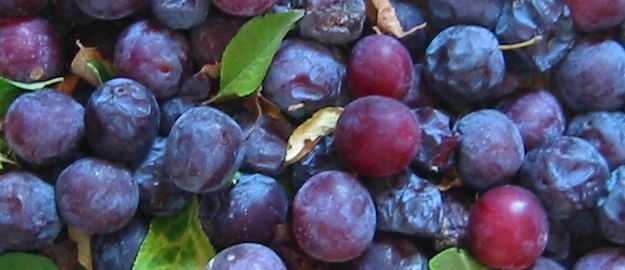
The blossom on the old ornamental plum trees makes it appear as if the snow has returned. In summer, these bear heaps of small plums, which look fabulous but sadly are not good for eating (not even for making jams or chutneys).
Honey Bee on ornamental plum (Prunus cerasifera)
fruit of the wild plum
Regarding the box (Buxus sempervirens), there are several smaller shrubs in the garden and one large tree, about 3 metres tall – Im guessing that that too has been around for decades.
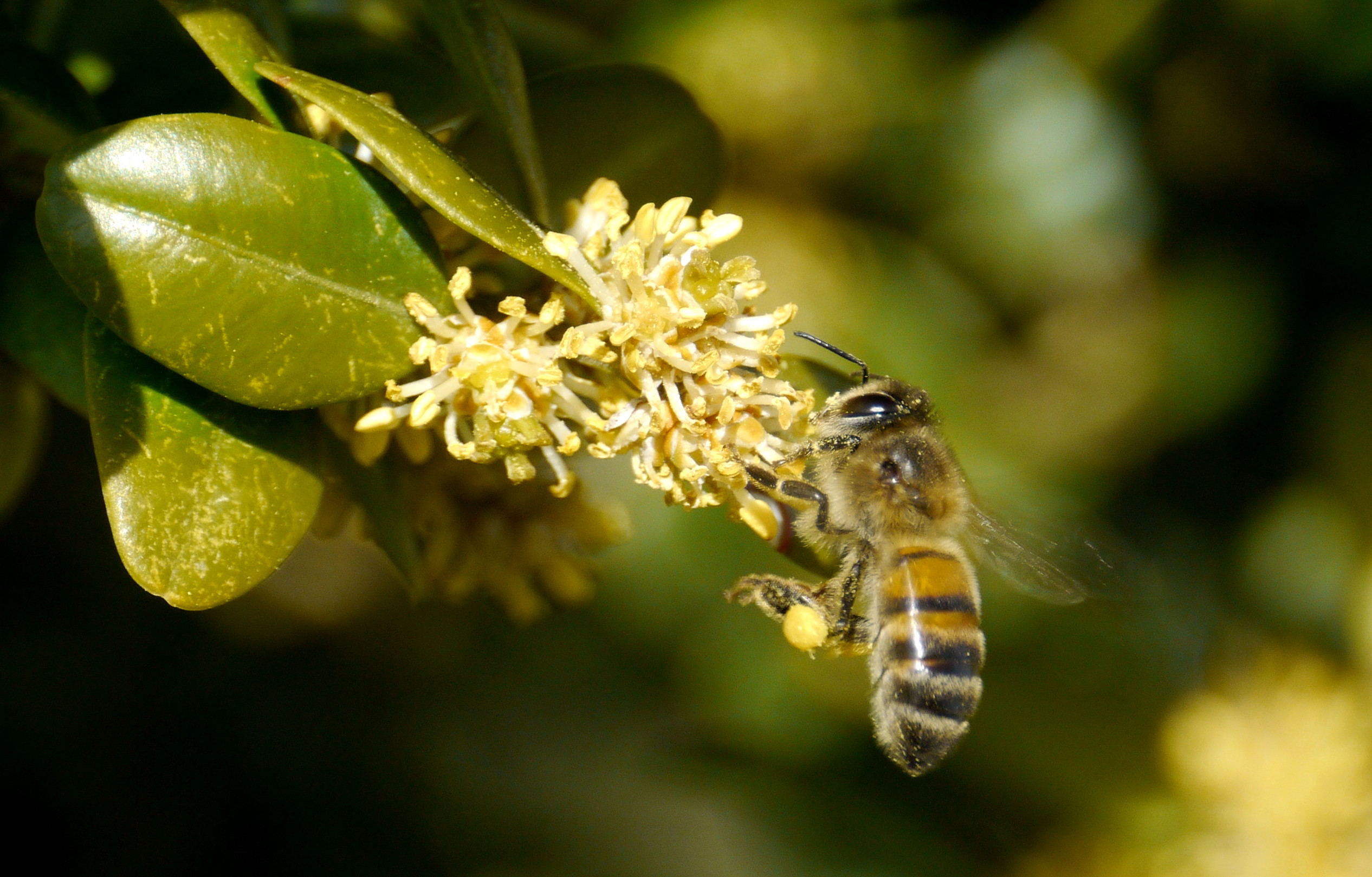
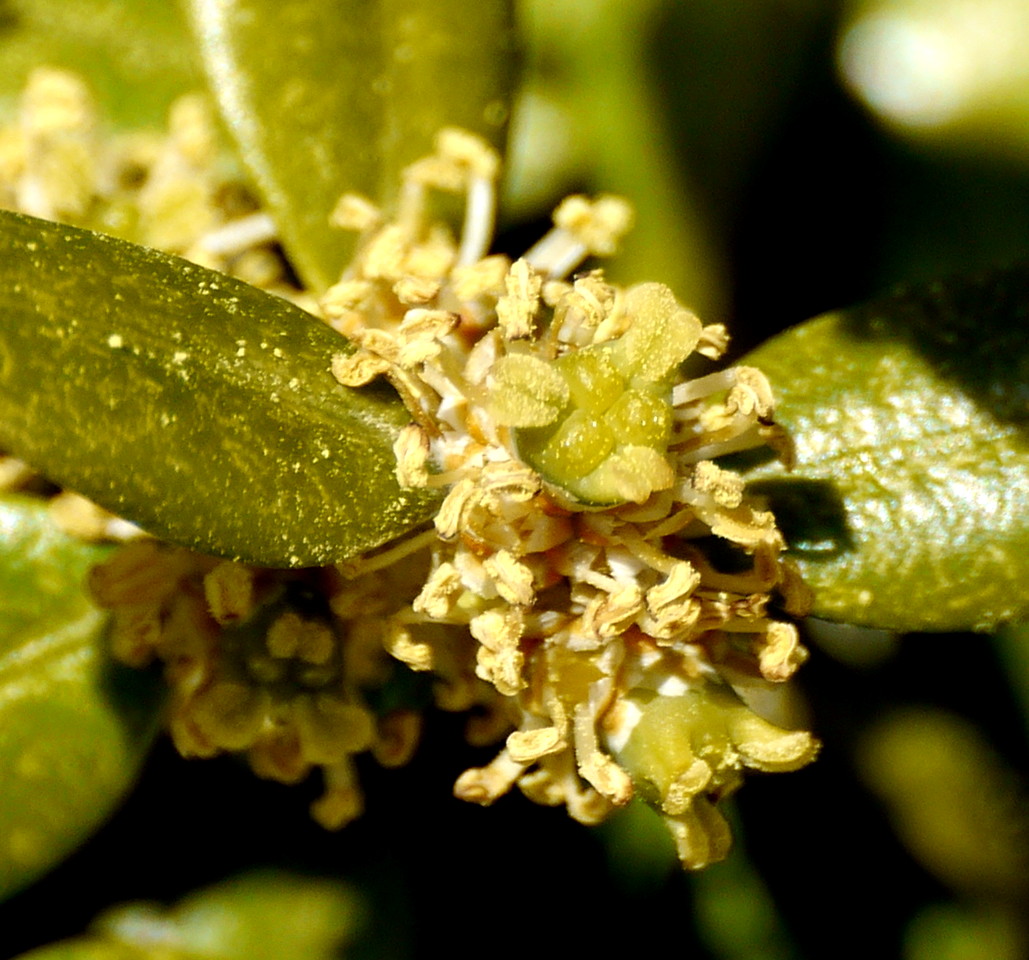
The box tree is monoecious – plants have their male and female parts on separate flowers, but together on the same plant. Flowers are green and grow in clusters in the leaf axils. Each cluster contains several male (staminate) flowers with conspicuous whitish-yellow anthers, and a terminal female flower containing a three-celled ovary.
Honey bees on Box – the staminate flowers visible (anther and filament)
Buxus flowers are not showy, but are quite fragrant. The female (pistillate) flower is small, star shaped and yellowish green. The star points are actually sepals – boxwood flowers have no petals.
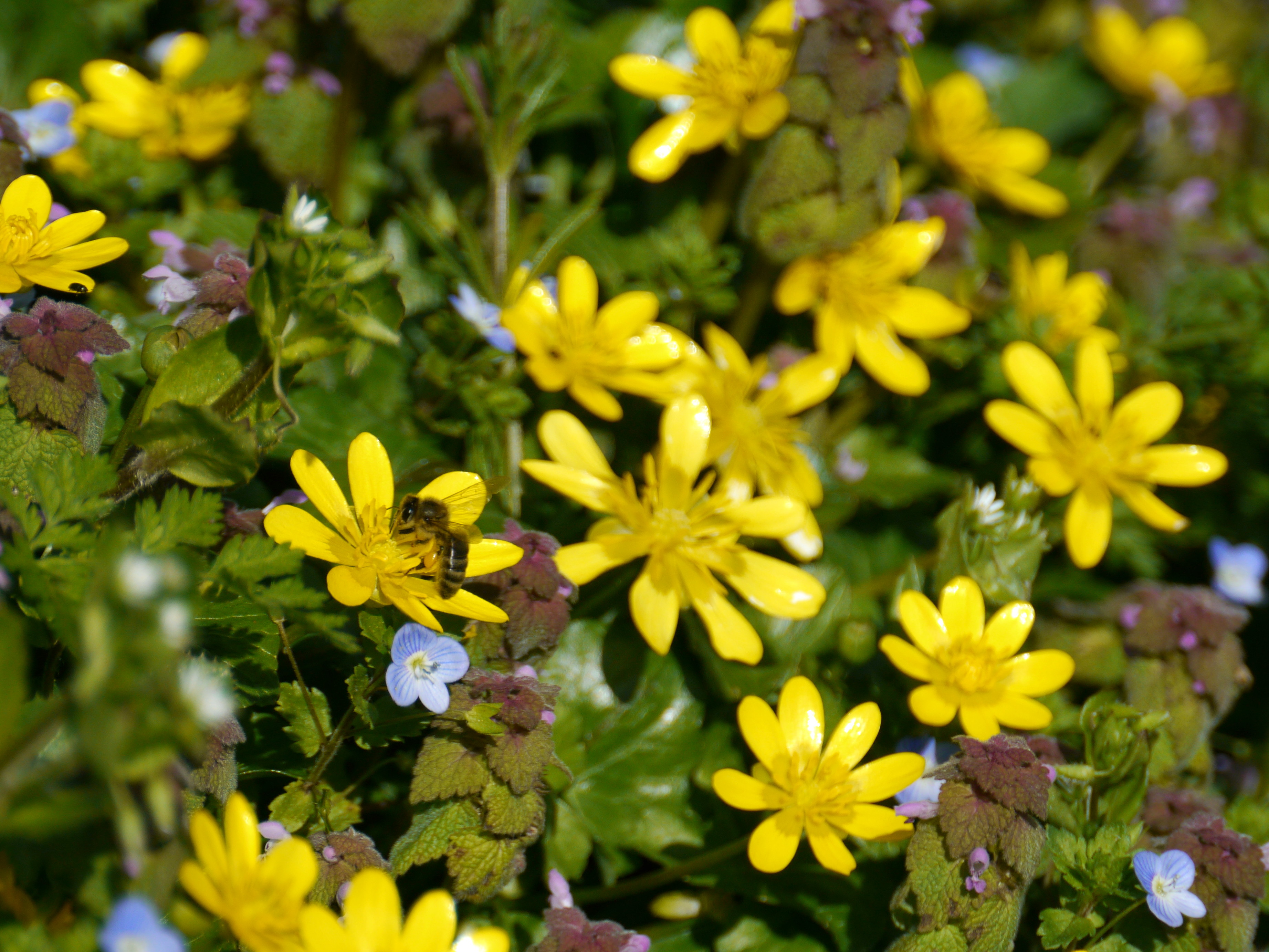
Just opposite the kitchen window is a southerly facing bank, which is covered in a thick carpet of wildflowers and weeds, with a hint of grass. At midday, it is a mass of colour, very picturesque, and is attracting a multitude of wildlife – especially bees.
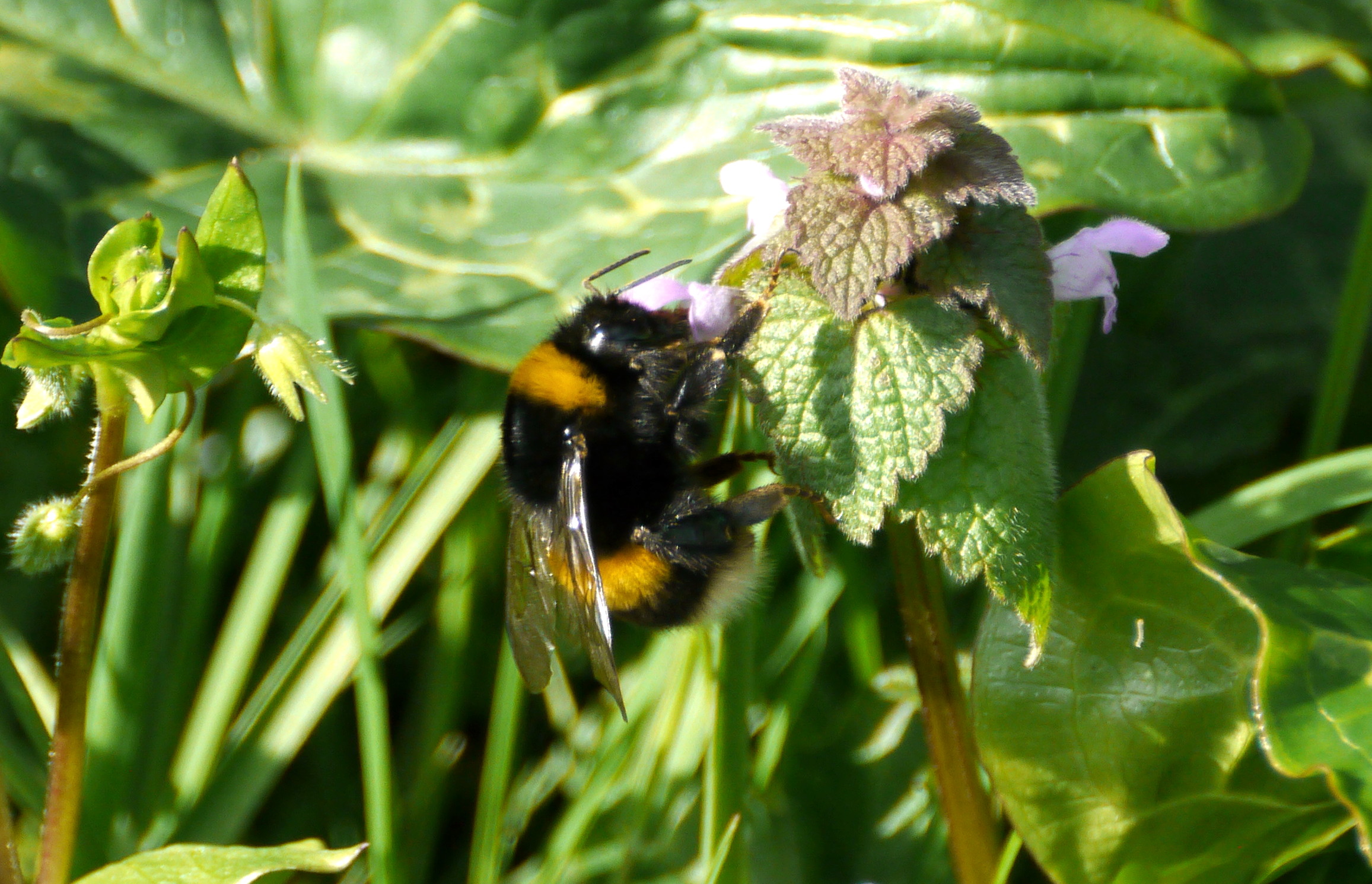
With all the buzzing, it doesn’t take a detective to track down some of the visitors. Especially when they are relatively large and sporting black and yellow furry stripes (with a cute white bottom)…
Bumblebee on Red Dead-nettle (Lamium purpureum)
There are one or two honey bees in the mix, gleaning every little they can. Most of their sisters are over at the box tree, which is currently pollen central (more of that in another post).
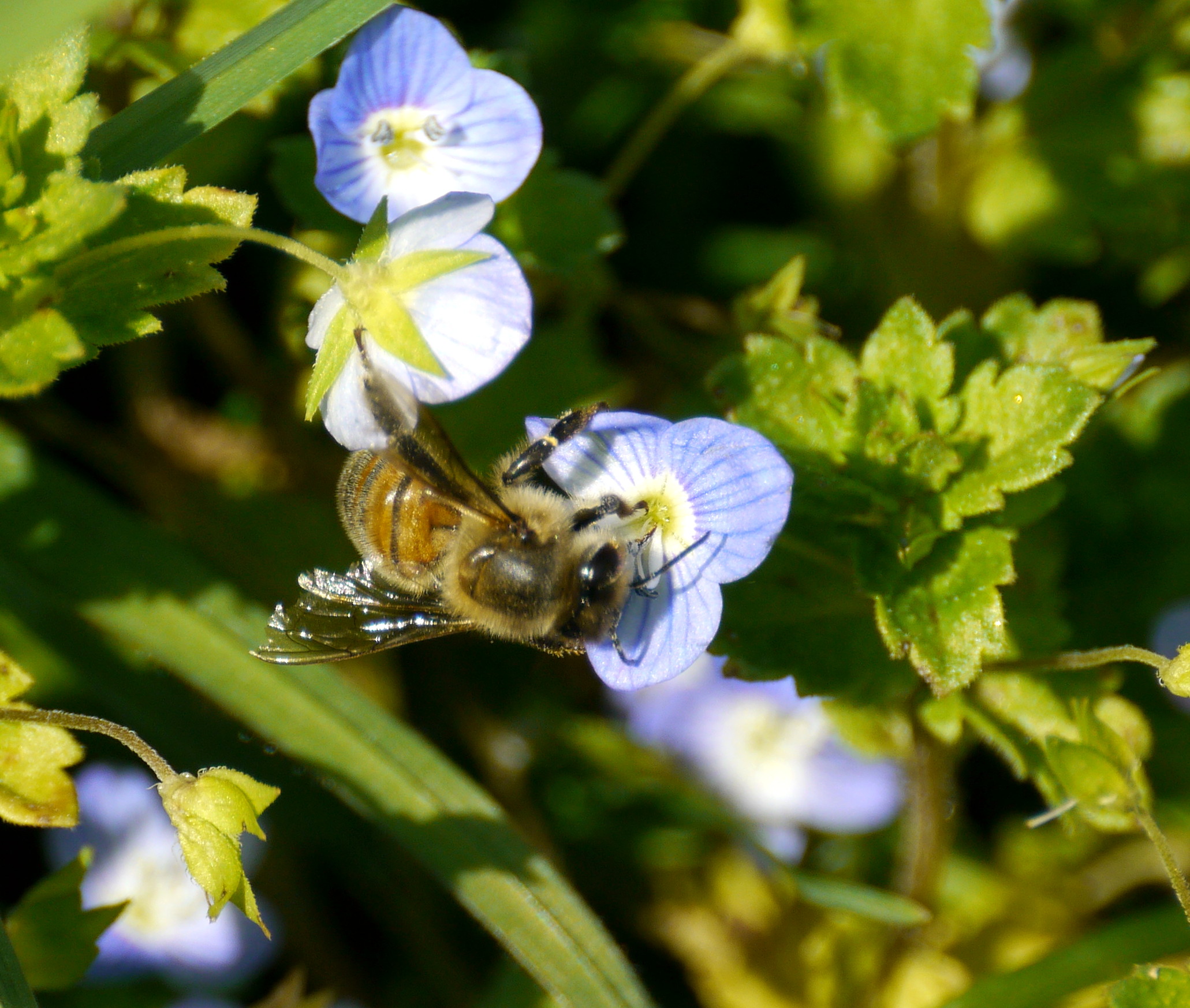
Honey bee on Common Field-speedwell (Veronica persica).
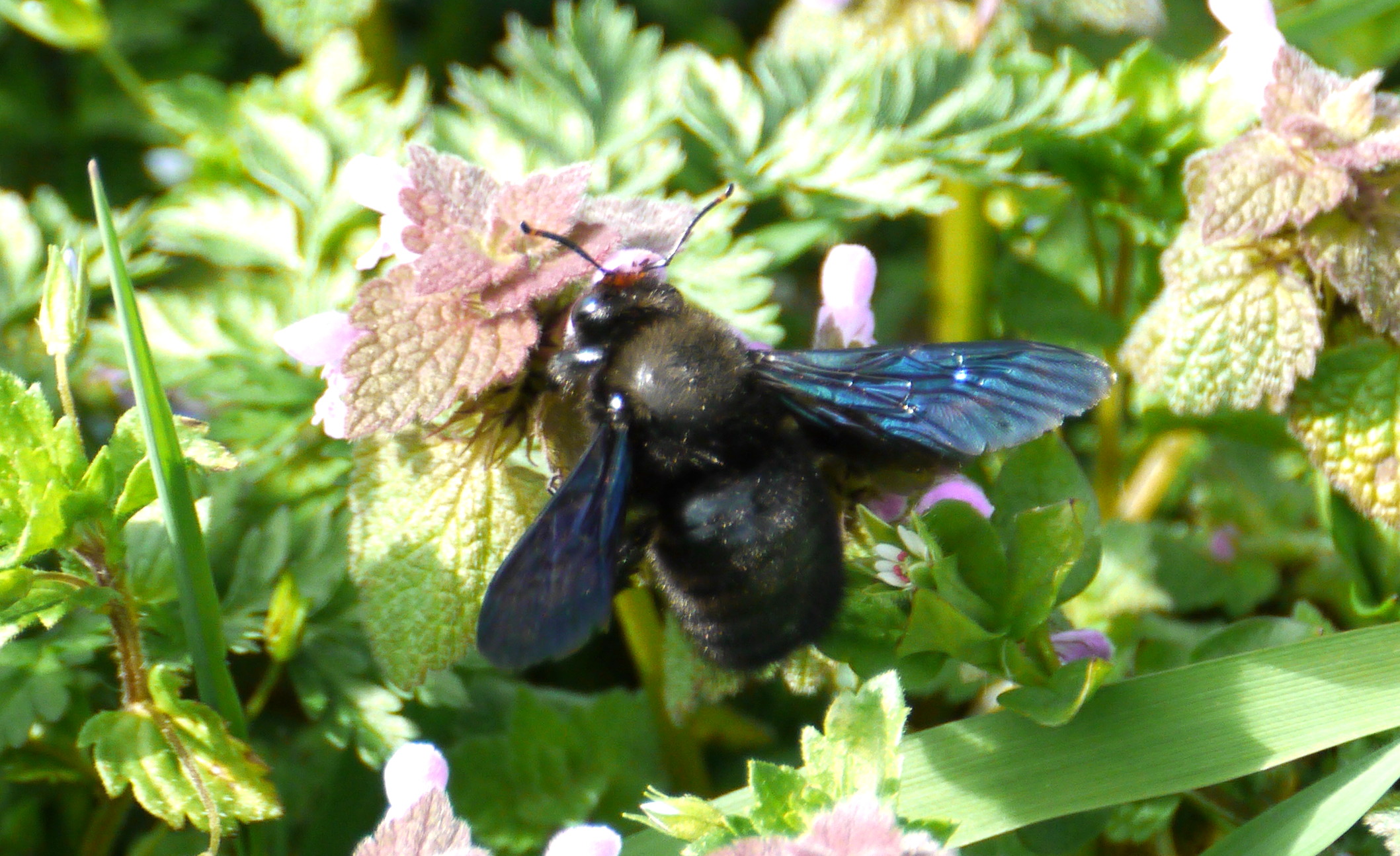
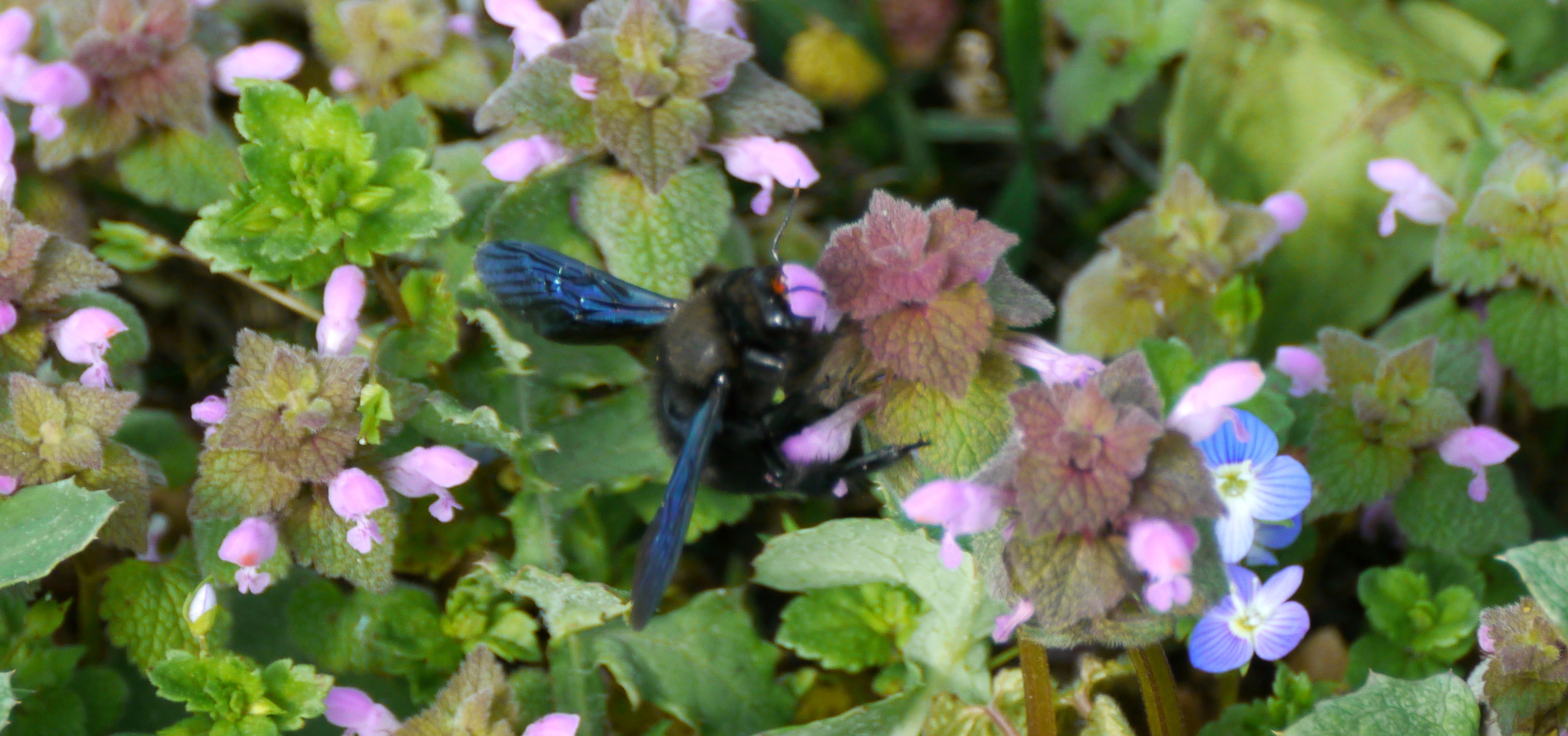
my new friend, the Carpenter Bee
and finally, something new to me, even though it is apparently one of the most common bumblebee species, here is the Common Carder Bee. It is medium-sized, has a long tongue and nests on the surface of the ground…
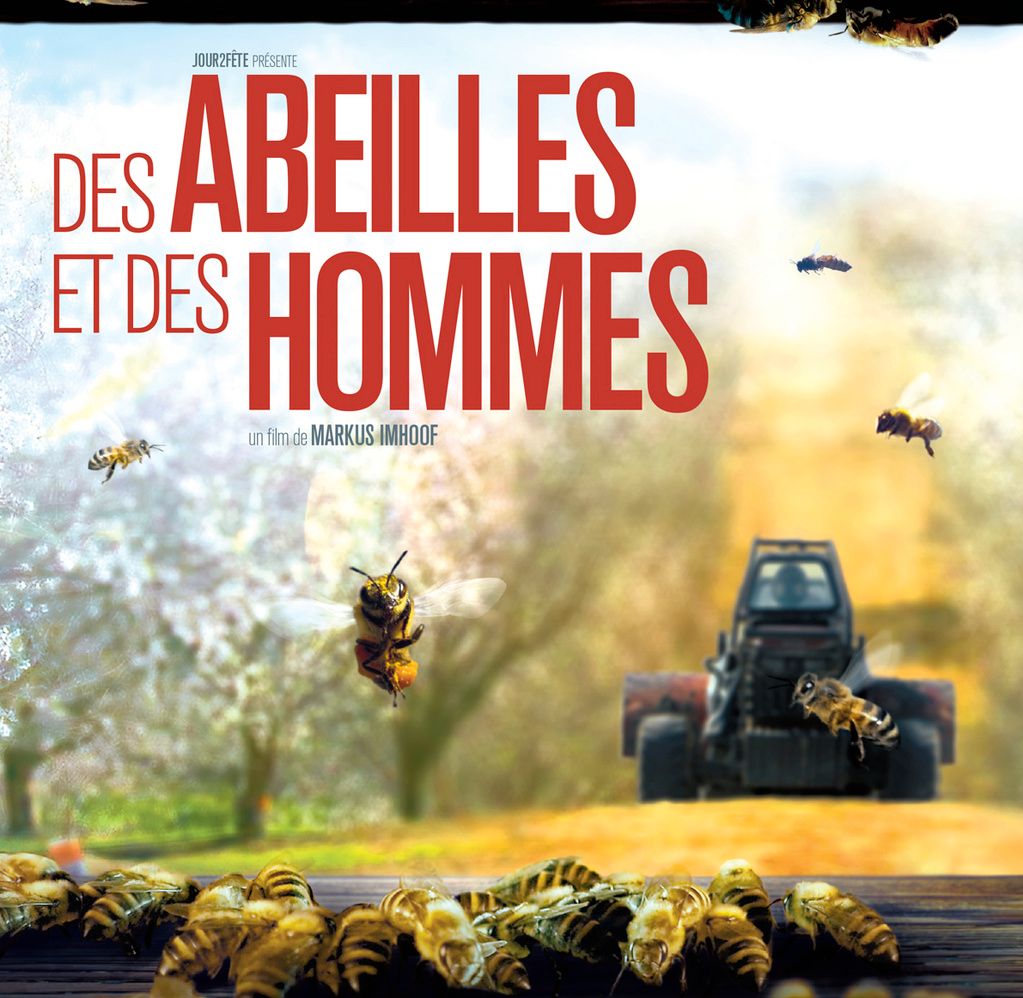
Last night we went to the cinema to watch a new documentary – Des Abeilles et Des Hommes (also called More Than Honey), reporting the decline in bee populations, and the multiple possible reasons behind this phenomenon. Swiss film producer Marcus Imhoof, journeys around the globe filming folk closely involved in bee-keeping – apiarists, honey producers, hive transporters, pollen gatherers etc, and each tells their story. The film lasts about 90 minutes, and comprises factual snippets, nuggets of information, some bee-keeping basics, all with beautiful cinematography including some amazing macro work.
The film begins in a stunning Alpine setting, with Fred who is out gathering a swarm, no hint of protective clothing. He is descended from a long line of bee keepers and can recall how things used to be. For him traditional methods are all important. Fred is fighting cross-breeding, striving to keep the local race of black bees pure. He discovers one of his queen bees has been interbreeding with a yellow bee from a neighbouring valley, and without compunction, squeezes off the head of this traitress.
The story moves to a vast almond producing area in California, and the associated honey producing / pollination operation. The scale is immense – and the driving force is money making. The orchards were alive with bees collecting pollen – but after just a short while the hives have to be transported on – as, once the pollen has been collected there is no more nourishment for the bees and for them it is has become a desert. The trees are fumigated during the day – and traces of fungide can be found in the resultant honey. Additionally the bees are fed antibiotics, to help assure the continued presence of this all important component of such industrialised agriculture.
We meet Heidrun Singer and her production line of Queen Bees – she gently transposes larvae into false royal cells, thereby tricking the bees into feeding them royal jelly. Apparently her queen bees are sold around the world – and we see them packaged up and hauled off by a courrier company.
Onto China, to an area where bees are so scare that pollination is done by hand – by human beings (mostly women). Pollen is collected and sold in small packets, and then a team of workers, armed with cotton buds, the pollen in a bottle round their necks, pollinate the trees, flower by flower.
Back to the US, to Arizona, where Fred (another Fred) works collecting Africanized Killer Bees. Having retrieved a swarm, he doesn’t destroy it, but rather keeps it – noticing that they are more hardy than their normal counterparts, produce good honey, but have to be treated with a good deal of respect.
There are further tales of Foul Brood, pesticides and the varroa mite. Evidence of stress sufferered when transporting the hives on the back of lorries for thousands of kilometers each year. Footage of bees fitted with tracking devices. We meet a German neuroscientist investigating bee brains. And much more.
This is not a film with a beginning, a middle and an end – it is educational, a neutral presentation of facts and information, from which we are allowed to draw our own conclusions. We see that traditional and natural methods, and unlimited growth may be unsustainable. Does the answer lie in a totally unexpected source?
The film is originally in German, and is available with French subtitles (there is a certain amount of spoken English).
What a difference a day makes. Yesterday, I was out planting primulas, admiring the cheery daffodils and noticing the first cuckoo. The bees were working at full speed, in and out all day long, their baskets full of pollen. There were even a couple of butterflies, and the fruit trees were all either in full blossom or about to burst forth.
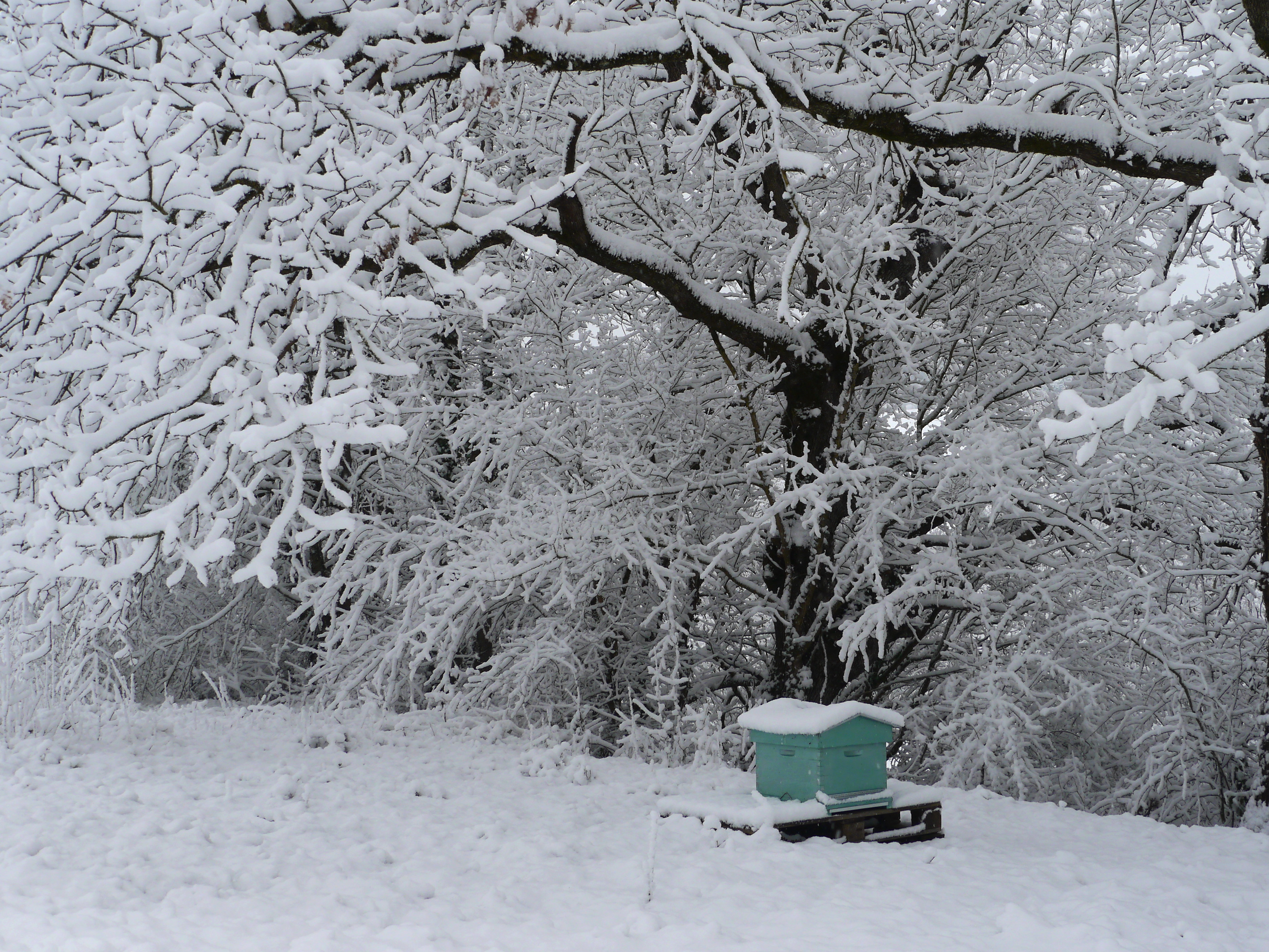
And this morning, I wake up to a blanket of snow, up to 6 inches deep. Its all quite photogenic, and isnt too cold, so I am guessing that it will all have melted away by tomorrow. I wonder what impact it will have on the fruit blossom?
Whilst trying to photograph a bumble bee, bumbling around in the now rather lush ground cover, my attention was drawn to this big black bug, behaving in much the same fashion as the bumble bee.
It had a loud buzz and was busy foraging within the flowers. But the body is glossy, heavy and black which made me think ‘beetle’. The wings are fabulous – a gorgeous irridescent blue.
Anyway, a quick google has provided the answer – it seems that I have met my first Carpenter Bee. Apparently fairly common in France, they make their home in old rotting trees, live a somewhat solitary existence, and are not aggressive and rarely sting.
In France, they are called the blue bee or abeille charpentiere and its Latin name is Xylocopa violacea.
Spring is in the air… finally. I have been itching to get and about with the camera for several days now, ever since the Japonicas burst into bloom with their beautiful, vibrant orange-pink flowers. I also noted that the almond tree wasn’t too far behind, with buds aplenty.
It has been warming up nicely, and apparently the bees won’t come out to actively forage until the temperature hits 13 degrees. And full foraging is not acheived until it warms up beyond 19 degrees. It was pleasantly mild at the beginning of the week, but then we were hit by a Vent d’Autan – a quite violent wind coming at us from the east, and this time gusting up to 60 kms/ hour. It lasted for 48 hours, and at times it felt like the roof of the house was coming off (luckily, it didn’t). I certainly didn’t feel like venturing forth, and I imagine the bees stayed indoors too.
Conditions yesterday were much improved, so off I trot with trusty camera to see what’s going down in honey bee world. And lo, there were the girls hard at work, collecting pollen from the stunning Japanese Quince (Chaenomeles japonica) bushes. All very photogenic – that’s the calendar image for March 2014 in the bag.
Just next to the Japonicas is a splendid almond tree, starting to blossom. I love this flower, with its tinges of pink and incredible perfume. The bees were here too, gathering up the yellow-brown pollen. This pollination work is important in the big almond producing regions of the world – the pollination of California’s almonds is the largest annual managed pollination event in the world, with close to one million hives (nearly half of all beehives in the USA) being trucked in February to the almond groves.
We have a whopping two trees, so hopefully the girls won’t bee too overwhelmed with the workload.
Remarkably the hawthorn tree at the front gate is starting to blossom. We have had some beautiful, mild days recently, but the nights are chilly and so it seems far too unseasonal to be seeing these flowers. The bees however have been quick to latch on and are busy collecting the pollen, as they do.
Its nice to be seeing them out and about again, and be able to wish them Happy Christmas.
The sunflowers now are in the equivalent of their their twilight years, past their bright yellow prime, all rather brown and withered, heads bowed towards the earth – it won’t be long before we are looking at a freshly ploughed field. Time to capture some final shots, and it seems sunset is the best time.
I now realise that sunflowers point permanently in the same direction all day long – namely to the East. The buds are heliotropic (a bit like me) and at the end of the bud stage all plants are polarized to face in the one direction.
The plants remain in the fields long after the beautiful yellow petals have shrivelled and died. The sunflower however is now busy sorting out its seeds, which considering that it is a commercial crop, is actually the reason for its existence, its raison d’etre.
The seeds will go on to be used to produce sunflower oil, to be used in cooking, as a carrier oil and to produce margarine and biodiesel. The cake remaining after the seeds have been processed for oil is used as a livestock feed.
These mature flowers have droopy heads, looking at the ground, which adds to their forlorn appearance – but this reduces bird damage and losses due to certain diseases.
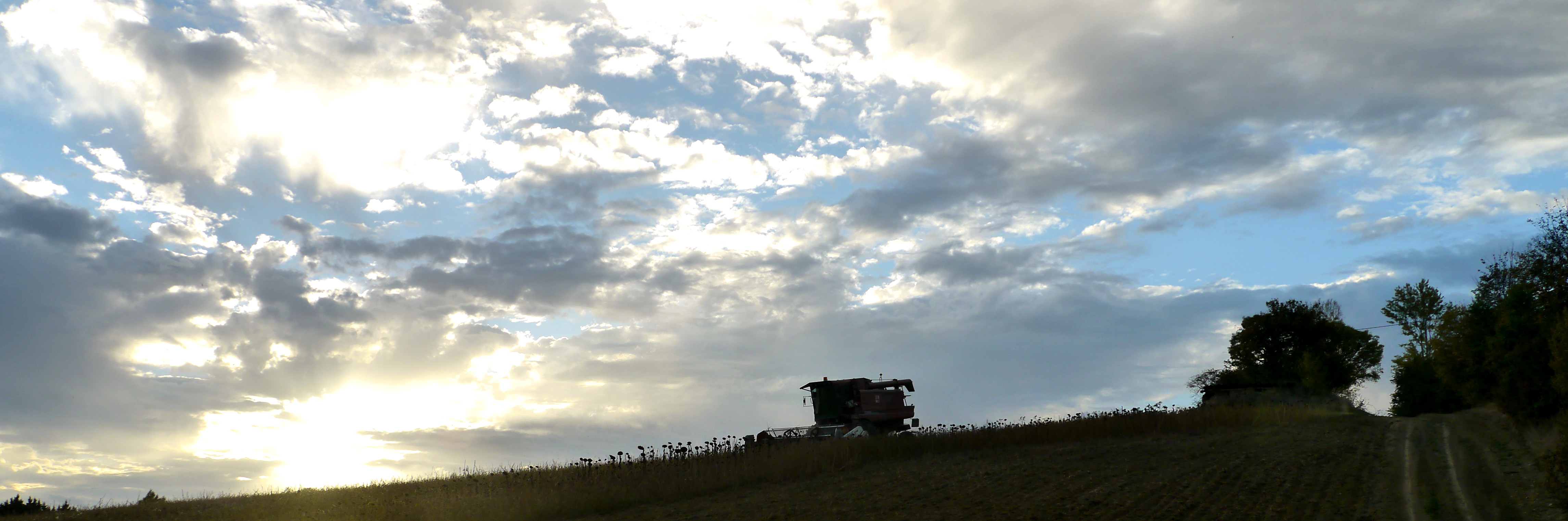
Its now early October and ‘our’ sunflowers are still there – but most of their compatriots have been gathered up and no doubt squashed and the oil extracted. I suspect Denys the farmer will be along soon with his noisy, ancient combine harvester to do the same.
UPDATE : the farmer has just been and harvested the sunflowers…















 Stick To Plan Bee